How De-Icing Salt Is Destroying Your Colorado Concrete (And How to Stop It)
Every Front Range winter, the same trucks that keep your street driveable are also working against your driveway, your sidewalk, and your garage floor. Colorado's de-icers do their job well — they melt ice and keep tires gripping pavement at temperatures where plain rock salt barely works. But the chemistry that makes them effective on ice is the same chemistry that pits, flakes, and eventually corrodes the concrete underneath. If you've noticed a driveway that looks worse every spring, this is almost always why.
What Colorado Actually Uses for De-Icing
Most Front Range municipalities and the Colorado Department of Transportation rely on two chloride-based de-icers: magnesium chloride (MgCl₂) and, less commonly, calcium chloride (CaCl₂). Both are different from the plain rock salt (sodium chloride) many homeowners picture when they think "road salt."
Chloride de-icers are used at altitude and in Colorado's cold snaps because they stay effective at much lower temperatures than sodium chloride, which loses melting power fast below about 20°F. MgCl₂ in particular is sprayed liquid on roads ahead of storms as an anti-icing measure, then tracked by tires onto driveways, into garages, and across sidewalks all winter long. It's effective winter-safety chemistry — and it's also the single most Colorado-specific cause of concrete damage on this site.
The Two-Part Damage Mechanism
De-icing salt doesn't just sit on the surface and wash away in the spring. It does two separate kinds of damage, and they compound each other.
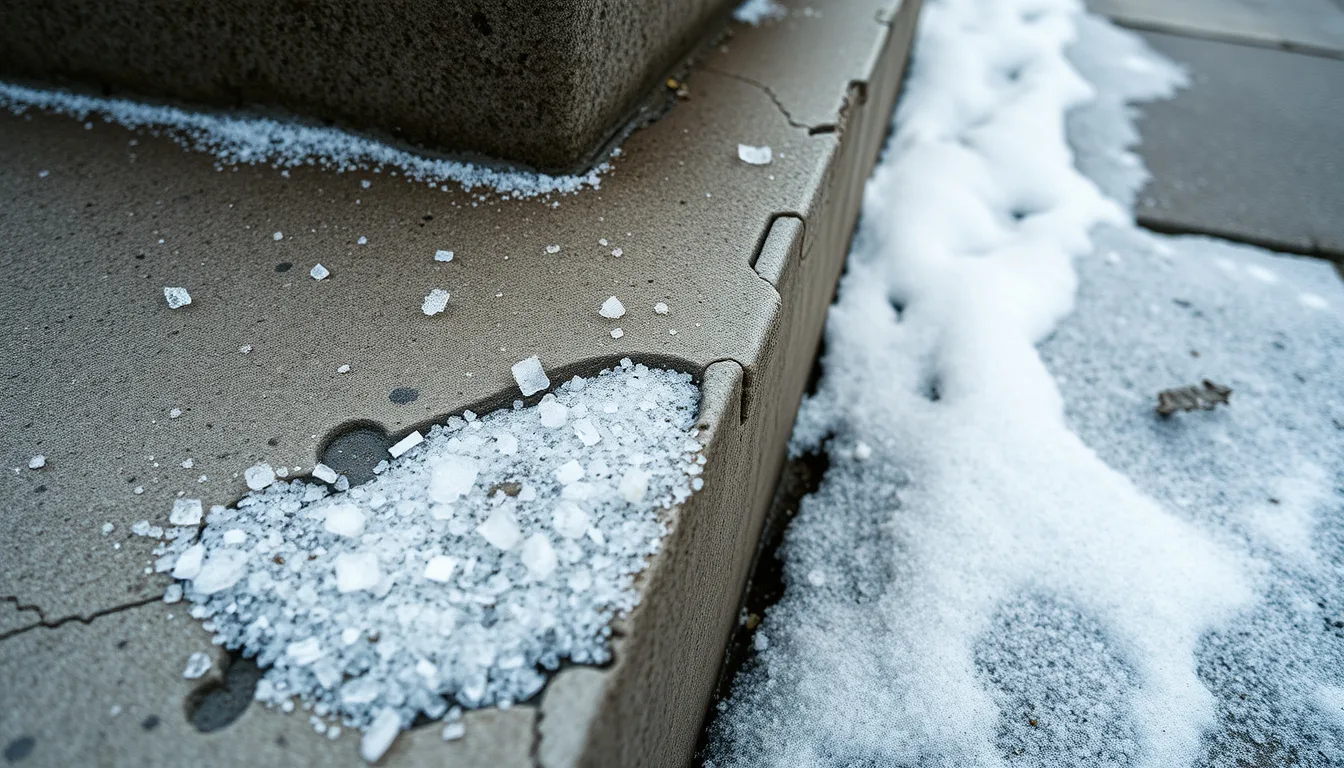
Accelerated freeze-thaw scaling. Concrete is porous, and chloride solutions increase the amount of water held inside that pore structure. More water in the pores means more water available to freeze — and freezing water expands roughly 9% in volume. On the Front Range, where Denver-metro concrete cycles through freeze and thaw an average of about 149 times a year, that extra pore water turns an already harsh freeze-thaw environment into a faster one. Each cycle pries the surface apart a little more, which is what produces scaling: the top layer of the slab flaking and peeling away to expose the rougher aggregate underneath.
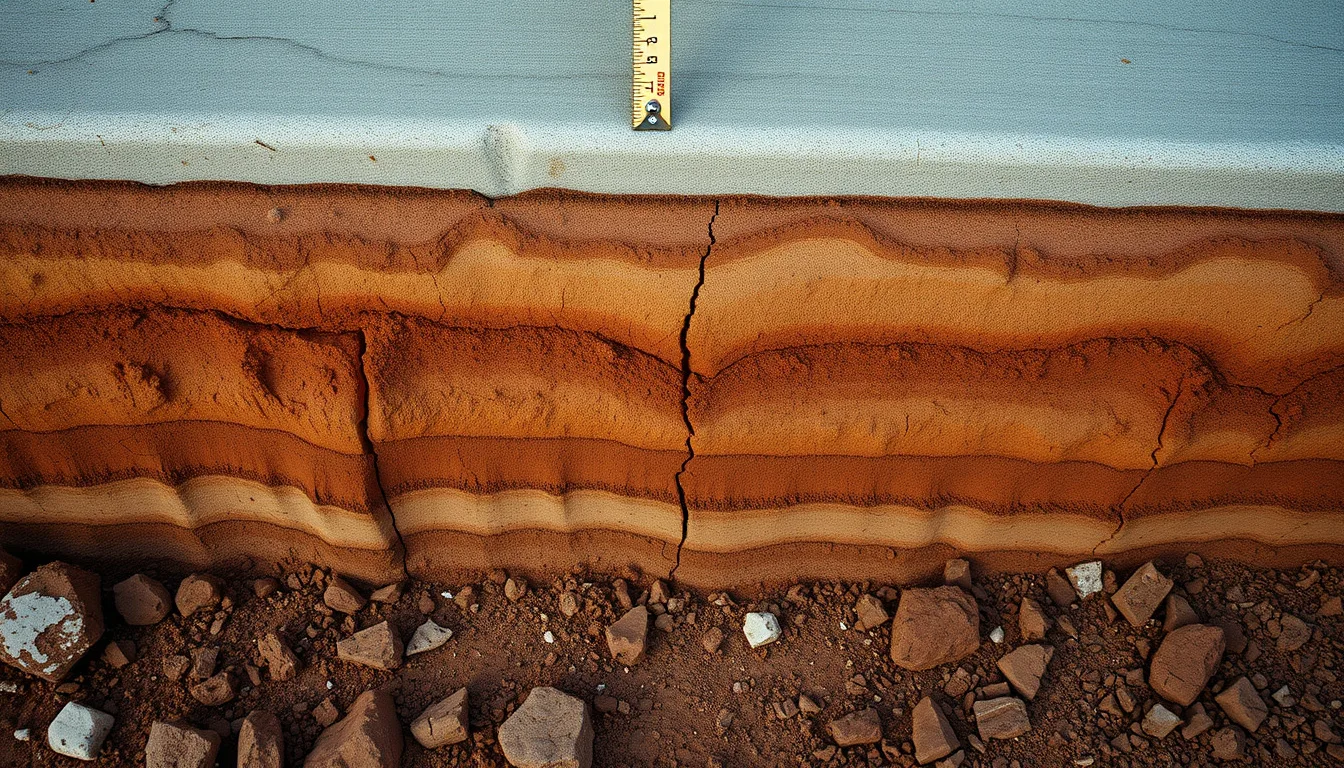
Rebar corrosion. The second mechanism works deeper and slower. Chloride ions from de-icing salt gradually penetrate through the concrete to any embedded steel reinforcement. Rebar is normally protected by a thin passive oxide layer, and chloride exposure breaks that layer down, allowing corrosion to start. Rusting steel occupies more volume than the original steel, so as corrosion spreads, it physically cracks and spalls the concrete around it from the inside out. This is how a driveway that starts with cosmetic surface scaling can progress into structural spalling — chunks of concrete breaking away at edges, corners, and joints — years later.
Why Magnesium Chloride Is the Worse Offender
Not all de-icers are equal, and the difference matters if you have any control over what gets applied on your own property. Per American Concrete Institute (ACI) durability guidance, calcium chloride has a "negligible" long-term effect on concrete, while magnesium chloride causes measurable, ongoing surface deterioration.
The numbers back that up directly. In controlled scaling tests using a 4% solution of each chemical, magnesium chloride produced "moderate scaling" — a rating of roughly 3.1 — while calcium chloride produced only "very slight to slight" scaling, around 1.6. That's roughly double the surface damage from MgCl₂ at the same concentration.
The corrosion gap is even wider. Magnesium chloride is reported to be more than twice as corrosive to stainless steel as calcium chloride, and up to 10 times more corrosive to mild steel — the type of reinforcement used in most residential driveways, sidewalks, and garage slabs. If you're choosing what to spread on your own concrete this winter, that's the single biggest lever you control.
Where the Damage Shows Up First
De-icing salt damage doesn't hit every surface equally. Three areas take the worst of it:
- Driveways — direct owner-applied de-icer plus salt-laden runoff and slush thrown off by plow trucks and passing traffic
- Sidewalks — the heaviest per-square-foot salt application of any surface on most properties, since walkways get treated repeatedly through a single storm
- Garage floors — an easy-to-overlook interior surface that takes concentrated chloride exposure all winter long, tracked in on every vehicle's tires and boots and left to sit and dry on an unsealed slab
Garage floors are a genuinely Colorado-specific problem. In most warmer states, an interior slab never sees this kind of chloride and moisture cycling. In Colorado, it's one of the more common spots we get called out to inspect in early spring.
Prevention Checklist
You can't stop winter, but you can significantly slow the damage:
- Seal exposed concrete before winter. A quality penetrating or film-forming sealer creates a barrier that reduces how much salt-laden water gets into the pore structure in the first place.
- Choose a less-corrosive de-icer on your own property. Calcium chloride or a sand-based traction product does far less damage than magnesium chloride for the same ice-melting job.
- Rinse salt residue when you can. Hosing off visible white residue after a storm, once temperatures allow, reduces how long chlorides sit in contact with the surface.
- Address joints and cracks before winter. Sealed joints and filled cracks give freeze-thaw water fewer places to collect and expand inside the slab.
- Sweep, don't just melt, on interior slabs. Garage floors benefit from regularly sweeping out tracked-in de-icer residue rather than letting it dry into the surface.
Warning Signs the Damage Has Already Progressed
Surface scaling is a cosmetic problem you can catch early. These signs mean it may have already reached the rebar:
- Rust staining bleeding through cracks or across the surface near joints and edges
- Hollow-sounding spots when you tap the slab, which can indicate a spall forming underneath an intact-looking top layer
- Popped-out chunks at slab edges, corners, or control joints — the classic sign of spalling in progress
- Widening or branching cracks that weren't there the previous winter, especially near known salt-exposure areas
If you're seeing any of these, the repair window is still open — but the longer corroding rebar sits, the more concrete it takes with it.
Repair Options by Stage
The right fix depends on how far the damage has progressed. Light surface scaling with a structurally sound slab underneath is typically resurfaced or overlaid rather than replaced. Isolated spalling can usually be chipped out and patched, with any exposed rebar cleaned, treated, and reinforced before new material goes back in. Widespread spalling with extensive corroded rebar is the point where full removal and recasting becomes the honest recommendation instead of another patch that won't hold.
Whatever stage you're at, we build a sealing plan into every repair so the fix isn't undone by the next winter's de-icer.
FAQ
Does de-icing salt actually damage concrete, or is that a myth?
It's real. The magnesium chloride and calcium chloride used as de-icers across Colorado roads, driveways, and walkways increase the water held inside the concrete's pore structure, which intensifies freeze-thaw expansion and accelerates surface scaling. Magnesium chloride in particular is documented to cause measurably more surface deterioration than calcium chloride.
Is magnesium chloride or calcium chloride worse for my concrete?
Magnesium chloride is the more damaging of the two. Testing shows it produces noticeably more surface scaling than an equivalent calcium chloride solution, and it's also far more corrosive to embedded steel rebar — more than twice as corrosive as calcium chloride to some steels, and up to 10 times more corrosive to mild steel. If you control what's applied on your own property, calcium chloride or a sand-based traction product is gentler on concrete.
Can de-icing salt damage make my rebar rust?
Yes. Chloride ions from de-icing salt eventually penetrate to embedded rebar and break down the protective layer that normally prevents corrosion. Rusting steel expands and physically cracks and spalls the concrete around it from the inside, which is how surface scaling can progress into structural spalling if it isn't addressed.
How do I stop de-icing salt from damaging my driveway and sidewalk?
Sealing the concrete creates a barrier that reduces how much salt-laden water penetrates the surface, and switching to a less-corrosive de-icer — calcium chloride or a sand-based traction aid instead of magnesium chloride — on your own property meaningfully slows future scaling. We recommend a sealing schedule as part of most repair jobs specifically to protect against this every winter going forward.
Get Ahead of Next Winter
If your driveway, sidewalk, or garage floor is already showing scaling, rust staining, or spalling, the fix is easiest and cheapest before the next freeze-thaw season starts working on it. We offer free inspections statewide, from Denver and Colorado Springs to Fort Collins, Boulder, and Pueblo, and we'll tell you plainly whether you're looking at a resurfacing job, a spall repair, or something further along.
Get in touch through our contact form for a free inspection before winter turns this season's scaling into next spring's spalling.
Ready for a real number?
Free inspections statewide — measured on site, fixed price before any drilling starts.