COMMERCIAL & INDUSTRIAL REPAIR
Commercial Concrete Repair in Colorado — Parking Lots, Walkways, and Warehouse Floors Repaired With Minimal Downtime
Commercial sites absorb the heaviest de-icing-salt load and the largest freeze-thaw and expansive-clay exposure of any property type in Colorado — and carry the greatest legal exposure when a walkway edge crosses the ADA trip-hazard line.
Who We Serve: Retail, HOA, Municipal, and Industrial Properties
Commercial concrete work covers a wide range of property types across Colorado: retail centers and strip-mall parking lots, HOA common-area walkways and pool decks, municipal and school district sidewalks and plazas, and warehouse or light-industrial floors, loading docks, and drive lanes. Each property type has different traffic patterns and different failure points, but the underlying causes of damage are the same three mechanisms driving every repair on this site — freeze-thaw cycling, de-icing salt chemistry, and expansive clay soil.
What changes at commercial scale is the size of the exposure. A single-family driveway might have one or two problem cracks; a retail parking lot or warehouse pad has acres of joints, hundreds of linear feet of curb and walkway, and dozens of individual panels that can each be at a different stage of freeze-thaw or salt-driven deterioration at any given time. Managing that at scale is a different job than a residential repair, and we schedule and document it accordingly.
Why Commercial Concrete Fails Faster in Colorado
Commercial properties get salted more aggressively and more repeatedly than almost any residential surface, because parking lots and loading docks carry constant vehicle and foot traffic and property managers salt for safety reasons all winter long. That means more magnesium chloride and calcium chloride exposure per square foot than a typical residence sees, and magnesium chloride in particular produces measurably more surface scaling and rebar corrosion than calcium chloride in equivalent testing.
Large paved surfaces also mean more total freeze-thaw joint stress area — every expansion joint and panel edge across a big lot is a place water can collect and cycle through the roughly 149 freeze-thaw cycles the Denver area averages each year, each cycle expanding trapped water about 9% and widening cracks a little further. And because a commercial pad covers more ground than a residential slab, it's more likely to cross variable soil conditions, producing differential settlement across the site as the Pierre Shale and bentonite clay beneath sections of the property swell and shrink at different rates.
ADA Trip-Hazard Compliance and Legal Exposure
Under the 2010 ADA Standards, any vertical change of 1/4 inch or more in a walking surface is a trip hazard, a change between 1/4 and 1/2 inch must be beveled at a 1:2 slope, and anything over 1/2 inch requires re-leveling or a ramp — this federal standard applies uniformly across every Colorado municipality. For a commercial property, an out-of-tolerance walkway edge sitting in a public-facing entrance or parking area is a measurable, documentable legal exposure that plaintiffs' representatives specifically look for.
Municipal ordinance exposure adds another layer for property managers to track. Denver's Ordinance 307 shifted public sidewalk maintenance and funding to a city-run Sidewalk Enterprise fee, while Colorado Springs keeps property owners legally liable for injuries even though the city maintains the sidewalk itself — two genuinely different frameworks that matter more for a commercial or HOA property manager tracking exposure across a portfolio than for a single homeowner. In either city, and everywhere else statewide, the private walkways, parking areas, and common-area concrete on the property itself remain the owner's or association's direct responsibility.
Minimal-Downtime Repair Scheduling
Commercial concrete rarely has the luxury of sitting out of service for days at a time. Polyurethane foam lifting and leveling reaches usable strength in roughly 15 minutes, which means we can level a settled dock apron, drive lane, or walkway section overnight and hand the area back at full capacity before the next shift starts — a meaningful difference from demolition-and-repour work, which can close an aisle or entrance for a week or more.
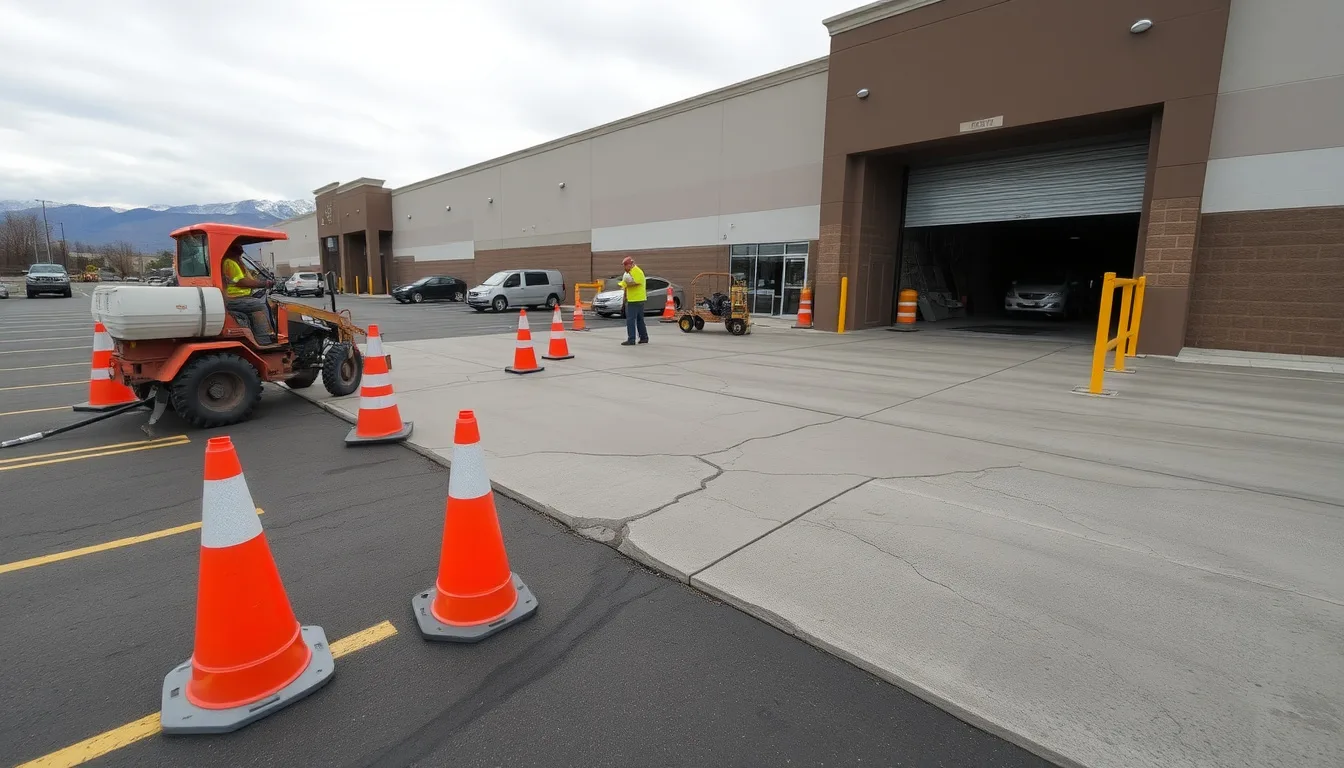
We schedule around your operating hours rather than ours: overnight windows, weekends, and holiday shutdowns for retail and warehouse sites; off-peak windows for HOA common areas; and coordinated phasing for municipal and school properties where public access needs to be maintained throughout the project. Work areas are coned and released section by section so the rest of the property stays fully usable while repairs are underway.
ADA Compliance Programs: Survey, Prioritize, Repair, Document
For property managers, HOAs, and facility directors responsible for large walkway or parking-lot inventories, we run trip-hazard surveys on an annual or seasonal cycle rather than waiting for an incident report to surface a problem. The output is a documented, dated record showing measured compliance work — the kind of paper trail that demonstrates a property was proactively maintained, not neglected, before anyone was ever hurt.
A standing annual program also turns unpredictable repair costs into a scheduled, budgeted line item, and it builds a year-over-year record of how quickly a given property's concrete is deteriorating, which helps with longer-term capital planning for parking lot or walkway replacement down the road.
- Full-property walkway and parking-lot survey measuring every panel edge against the 1/4-inch ADA threshold
- Prioritized repair list — worst edges and highest-traffic paths addressed first
- Section-by-section repair scheduled around business hours, tenant access, or public use
- Dated repair log with before-and-after documentation for facility and liability records
- Follow-up inspection cadence timed after spring thaw, when the prior winter's damage is most visible
Statewide Dispatch Across Every Colorado Metro
Commercial and municipal properties don't cluster in one metro, and neither does our dispatch. We cover the Denver metro core — Denver, Aurora, Lakewood, Arvada, Westminster, Thornton, and Centennial — along with Colorado Springs, Fort Collins, Boulder, and Pueblo, plus mountain-corridor commercial sites that see even harsher freeze-thaw exposure than the Front Range baseline due to thinner air and intense high-altitude sun driving rapid melt-refreeze cycling.
For multi-site portfolios spanning several of these markets, we run one program with a single point of contact and one consistent documentation format across every location, rather than coordinating separate local contractors per city. That consistency matters most for regional property managers who need the same ADA survey format and repair standard whether the site is a Denver retail pad or a Colorado Springs school campus, and it means a mountain-corridor commercial property doesn't fall through the cracks of a Front Range-only service map the way it might with a smaller local contractor.
Cost, RFQ Process, and What to Expect
Commercial pricing follows the same repair-method structure used on residential work — crack injection by the linear foot, resurfacing and overlay by the square foot, lifting and leveling by section and void volume — scaled to the property's total footage and phased into a project budget rather than one lump estimate. Larger sites typically get a tiered proposal: urgent ADA and safety items addressed first, followed by scheduled preventive work on sections that are trending toward failure but aren't yet a hazard.
We work directly from site plans, photos, or an RFQ for larger portfolios, and a walk-through for a single property typically takes under an hour before scaling up for multi-site work. Every commercial quote is fixed after that walk-through, and every repair is logged and documented the same way whether it's one dock apron or a full parking-lot resurfacing program.
Request a Commercial Assessment
Whether you're managing one retail parking lot, an HOA's entire common-area concrete inventory, or a warehouse floor with a growing list of problem joints, we'll walk the property, measure against the ADA standard, and give you a prioritized, fixed-price scope before any work is scheduled. Statewide dispatch covers Denver metro, Colorado Springs, Fort Collins, Boulder, Pueblo, and the mountain corridor.
Get in touch through our contact form to schedule a commercial assessment or submit an RFQ. Most commercial walk-throughs are scheduled within the week, with night and weekend work windows available from the first visit onward.
Commercial Concrete Repair FAQs
Straight answers before we drill
Under the 2010 ADA Standards, any vertical change of 1/4 inch or more in a walking surface is a trip hazard. A change between 1/4 and 1/2 inch is only acceptable if beveled at a 1:2 slope, and anything over 1/2 inch requires re-leveling or a ramp. This standard applies statewide and is separate from any city-specific sidewalk ordinance.
Ordinance 307 shifted public sidewalk construction and maintenance to a city-run program funded by a property-owner fee, but that applies specifically to the public right-of-way sidewalk fronting a property. Private walkways, parking areas, and common-area concrete on the property itself remain the owner's or HOA's direct responsibility, in Denver and statewide.
Often very little. Polyurethane foam lifting reaches usable strength in about 15 minutes, so a settled dock apron, drive lane, or walkway can be releveled overnight and returned to full use before the next shift or business day. We schedule around your operating hours, including nights, weekends, and holiday shutdowns.
Commercial properties are salted more aggressively for safety and liability reasons, exposing more square footage to magnesium chloride and calcium chloride each winter. Larger paved areas also mean more total freeze-thaw joint stress and a higher chance of crossing variable expansive-clay soil conditions, producing differential settlement across a single site.
Yes — we run annual or seasonal trip-hazard surveys for property managers, HOAs, and facility directors, measuring every panel edge against the ADA threshold and producing a dated repair log. It turns unpredictable repair costs into a scheduled budget item and creates documentation of proactive maintenance.
Cracked, sinking, or salt-damaged concrete? Get a fixed price before we drill.
Free inspections statewide. We diagnose freeze-thaw, de-icing salt, and expansive-soil causes before recommending a repair.