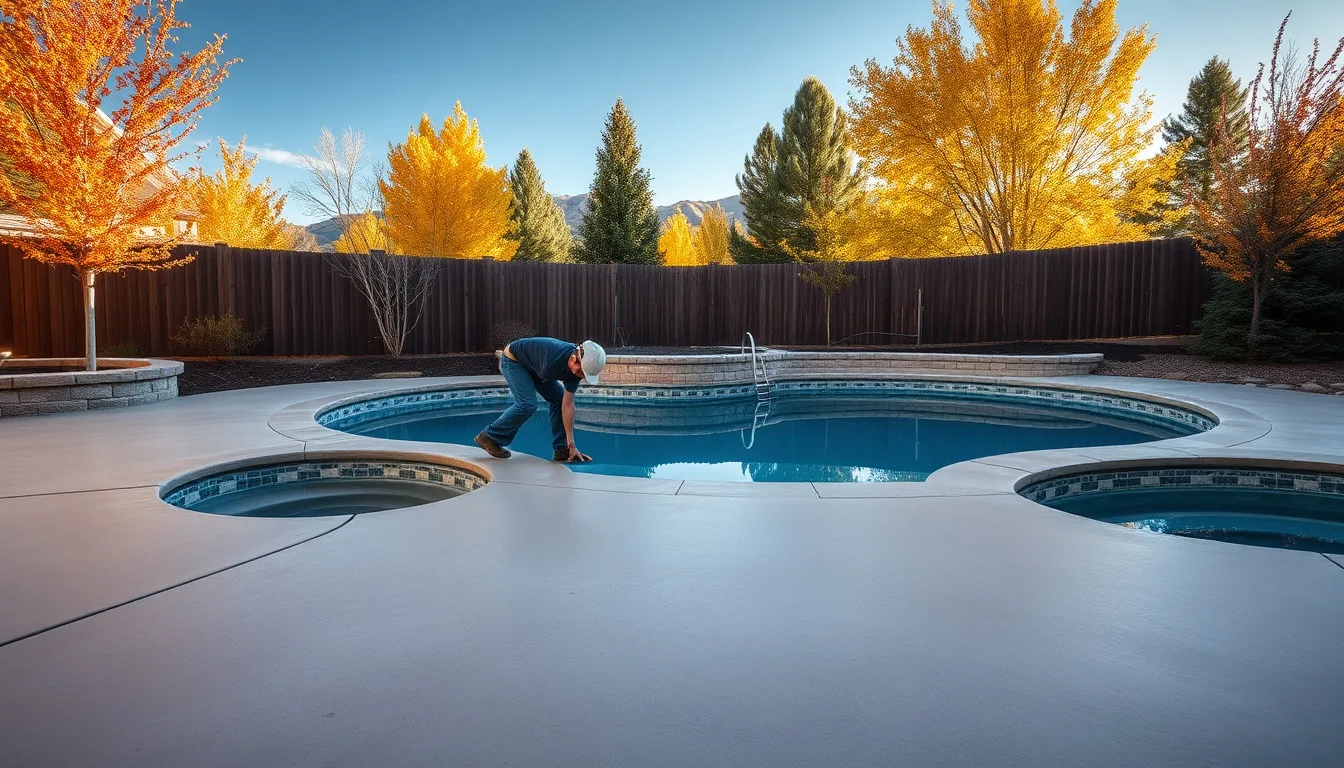
POOL & SPA DECK REPAIR
Pool Deck & Pool Surround Repair in Colorado — Level and Restore Concrete Around Front Range Pools and Hot Tubs
Pool and hot tub decks sit over backfilled excavation around the shell — the same expansive clay that heaves patios and driveways — and often take direct de-icing exposure near spa surrounds kept ice-free all winter.
Why Pool Decks Heave and Settle Unevenly
Installing an in-ground pool or hot tub means excavating well beyond the shell itself, then backfilling the over-dig with disturbed soil before the surrounding deck gets poured. That backfill zone behaves exactly like the backfill against a house foundation: it's the first place expansive Front Range clay concentrates its seasonal swelling and shrinking, since disturbed soil absorbs moisture faster and less evenly than undisturbed ground.
The result is a deck that moves unevenly around the pool's perimeter rather than as one uniform surface — one section heaves while an adjacent section, over slightly different backfill or a different distance from the shell, stays flat or even settles. Documented seasonal ground movement of roughly 2 to 6 inches in affected Front Range areas is more than enough to produce a visible, walkable trip step between adjacent deck panels within just a season or two.
This is a genuinely different failure pattern than a driveway or patio sees on more uniform undisturbed soil, because a pool deck's backfill ring varies in depth and compaction all the way around the shell. Deeper backfill near the equipment pad, a steep excavation corner, or a wide expansion joint often moves more than a shallower section near a straight run of deck, which is why pool deck unevenness so often shows up as a series of individual panel steps rather than one uniform tilt across the whole surface.
The Real Danger: Decks Tilting Toward the Shell
A deck section that settles or tilts toward the pool shell is a more serious problem than uneven decking alone — it changes how water drains around the pool, sending runoff and splash-out back toward the shell instead of away from it, which keeps the backfill wetter and accelerates the same clay swelling that caused the tilt. Around a raised hot tub or spa surround, a tilting or sunken deck section can also create a gap or unsupported overhang at the structure's edge.
We check the actual grade and the deck-to-shell relationship with a level during every inspection, not just the visible cracks, because a pool deck that's tilting toward the water can look only mildly uneven from a standing view while already representing a meaningful trip hazard and drainage problem at pool's edge. Left uncorrected long enough, a persistently wet backfill zone at the shell edge can also start affecting the coping and bond beam connection, turning what started as a drainage nuisance into a more involved repair that's best caught during a routine inspection rather than after a visible problem develops.
De-Icing Salt Scaling Near Hot Tub and Spa Surrounds
Pool decks generally sit dormant and covered through winter, but hot tub and spa surrounds are a different story — many Colorado homeowners keep the deck area around a hot tub clear of ice all winter for safe year-round access, which means direct application of magnesium chloride or calcium chloride right at the deck's edge. That's the same chemistry driving driveway and sidewalk scaling: magnesium chloride produces a moderate scaling rating (roughly 3.1) versus about 1.6 for calcium chloride in equivalent testing, and it's meaningfully more corrosive to any embedded rebar or mesh.
Pool decks also stay wetter than most other flatwork thanks to splash-out and any winterized-but-exposed sections holding moisture, and freeze-thaw cycling is measurably more aggressive on a surface that's frequently wet than on a dry slab. Combined with de-icer application near a spa, that makes hot tub surrounds one of the faster-scaling surfaces we see on residential Colorado properties.
Lifting, Leveling, or Resurfacing Without Losing the Finish
Most pool decks carry a decorative finish — exposed aggregate, a broom or stamped texture, an acid stain, or a cool-deck coating — that a full tear-out and repour can't replicate exactly, which makes lifting and resurfacing the preferred path whenever the base concrete is still structurally sound. A sunken or heaved section gets lifted and releveled with polyurethane foam injected through small entry holes, restoring a flush surface around the shell without disturbing the surrounding finish.
Where the surface itself has scaled or pitted from salt exposure but the slab underneath is solid, resurfacing restores a uniform, sealed surface — and can often match or closely approximate the original decorative finish so the repaired section doesn't stand out against the rest of the deck. We sequence these correctly: level first if the deck has any active unevenness, then resurface, so the new surface isn't installed over a slab that's still moving.
Protecting the Deck Through the Next Winter
Once a deck is leveled and resurfaced, sealing is the single most effective thing an owner can do to slow the next round of damage. A quality sealer reduces how much moisture and de-icer-laden water the concrete's pore structure absorbs, which matters most on the sections closest to a hot tub or spa surround where chlorides get applied directly. We recommend a resealing schedule as part of most deck repairs specifically because Colorado's freeze-thaw and salt exposure don't stop after one job — they resume the following winter.
For hot tub and spa areas kept clear of ice through the season, switching to calcium chloride or a sand-based traction product in place of magnesium chloride is a simple, no-cost change that meaningfully reduces future scaling, since magnesium chloride is the more corrosive of Colorado's two common de-icers. Controlling irrigation and splash-out runoff away from the backfill zone around the shell also slows the clay-swelling cycle that drives uneven settlement in the first place.
Typical Pool Deck Repair Cost
Lifting and releveling a sunken or heaved deck section is priced by square footage and the volume of void that needs filling underneath, generally less than the cost of removing and repouring the same area — and it preserves the existing decorative finish, which a fresh pour cannot match. Resurfacing runs roughly $3 to $5 per square foot for a basic finish, up to about $9 per square foot for more extensive damage, with decorative stamped, textured, or acid-stained finishes running $7 to $20 per square foot.
Crack repair around the deck or at expansion joints follows standard linear-foot pricing, from about $5 per linear foot for hairline caulking up to $25-plus per linear foot for reinforced structural injection on wider cracks. As with every service, we quote a fixed price after inspecting the deck in person, since the mix of lifting, crack repair, and resurfacing needed varies significantly deck to deck. A deck with only one or two uneven panels near the equipment pad costs far less to correct than a full-perimeter releveling job, which is exactly why we scope each section individually rather than pricing by total deck square footage alone.
Get a Free Pool & Spa Deck Inspection
If your pool deck has a step at one of the panel joints, is tilting toward the shell, or your hot tub surround is scaling from winter de-icer use, all three are worth addressing before the next wet-dry swing or winter season makes them worse. We inspect the grade, the deck-to-shell relationship, and the surface condition together.
Get in touch through our contact form for a free pool or spa deck inspection anywhere along the Front Range or statewide — inspections and quotes are always free, and we'll tell you honestly whether your deck needs a targeted lift, a full resurfacing, or both, how to time the work around your pool season, and what to expect for cure time before the deck can safely take foot traffic again.
Pool Deck Repair FAQs
Straight answers before we drill
Pool and hot tub decks sit over backfilled soil from the original excavation, which is exactly where Front Range expansive clay concentrates its seasonal swelling and shrinking. Because backfill absorbs moisture unevenly, adjacent deck sections can move differently from each other, producing a visible step at panel joints even though the pool shell itself stays put.
Yes, more than it looks. A deck section tilting toward the shell reverses drainage, sending water back toward the pool edge instead of away from it, which keeps the backfill wetter and accelerates further clay swelling. It's also a trip hazard at pool's edge even when the tilt looks minor from a standing view — we check actual grade with a level during inspection rather than relying on visual assessment alone.
Many homeowners keep the deck around a hot tub or spa clear of ice all winter for safe access, which means direct de-icing salt exposure right at that section. Magnesium chloride, Colorado's more common de-icer, produces measurably more surface scaling than calcium chloride, and pool decks generally stay wetter than other flatwork, which makes freeze-thaw scaling more aggressive there too.
In most cases, yes. Lifting and leveling a sunken section, and resurfacing a scaled or pitted area, both preserve or closely match an existing exposed-aggregate, stamped, or stained finish — a full tear-out and repour is reserved for decks with structural damage a targeted repair can't fix.
Lifting and releveling a sunken deck section is priced by square footage and void volume, generally less than removal and repour. Resurfacing runs roughly $3 to $9 per square foot depending on damage extent, with decorative finishes running $7 to $20 per square foot. We provide a fixed price after an on-site inspection, since deck-to-deck needs vary widely.
Cracked, sinking, or salt-damaged concrete? Get a fixed price before we drill.
Free inspections statewide. We diagnose freeze-thaw, de-icing salt, and expansive-soil causes before recommending a repair.