PATIO REPAIR
Concrete Patio Repair in Colorado — Fix Cracking, Heaving, and Drainage Problems Where the Backyard Meets the House
Patios sit directly on the backfill against your foundation wall, exactly where Front Range expansive clay concentrates its seasonal movement — and they take the full brunt of freeze-thaw with no traffic to keep ice from lingering.
The Patio's Weak Spot: Backfill Against the Foundation
Every concrete patio in Colorado sits on backfill placed against the house's foundation stem wall during construction — soil that was excavated, disturbed, and put back, rather than left in its original undisturbed state. That backfill is exactly where Front Range expansive clay movement concentrates, because it's already loose and quick to absorb whatever moisture reaches it from irrigation, rain, or snowmelt running off the roofline.
That's a different situation than the middle of a driveway or a sidewalk in the open yard, where the soil underneath is more likely to be undisturbed. A patio effectively straddles the boundary between the house's disturbed backfill and the yard's natural grade, which is part of why patio cracking and heaving so often shows up first and worst right along the wall line where the patio meets the house.
Why Patios Tilt Toward the House Instead of Away From It
The Pierre Shale and bentonite-bearing claystone common across the Denver metro, Colorado Springs, and Pueblo corridor is composed largely of montmorillonite clay, which swells when wet and shrinks when dry — seasonal ground movement of roughly 2 to 6 inches has been documented in affected Front Range areas. Because a patio's backfill zone absorbs moisture unevenly (more near the foundation, where downspouts and roof runoff concentrate water), that section of clay often swells more than the yard-side edge of the same slab.
The result is a patio that tilts back toward the house rather than sloping away from it — which is more than a cosmetic problem, since water then pools against the foundation instead of draining off, feeding the very clay swelling that caused the tilt in the first place. It's a feedback loop that gets worse each wet season until the drainage direction is physically corrected as part of the repair.
Freeze-Thaw Damage Lingers Longer on a Patio Than Almost Anywhere Else
A driveway gets cleared by tires and often shoveled because a car needs to use it; a sidewalk gets shoveled because people need to walk on it safely. A patio usually gets neither — snow and ice sit on it, uncleared, for as long as the weather allows, which means it experiences more of the roughly 149 freeze-thaw cycles the Denver area averages each year in a genuinely wet, actively-cycling state rather than a dry one.
That extra dwell time matters mechanically: water trapped in the concrete's pores expands about 9% every time it freezes, and the longer ice sits on a slab, the more melt-refreeze cycles it goes through before it's finally cleared. Unprotected, unsealed patio concrete can begin surface scaling within just 2 to 5 years under this kind of repeated exposure — often visibly worse than the driveway on the same property.
Diagnosing the Damage: Cracking, Heaving, and Negative Slope
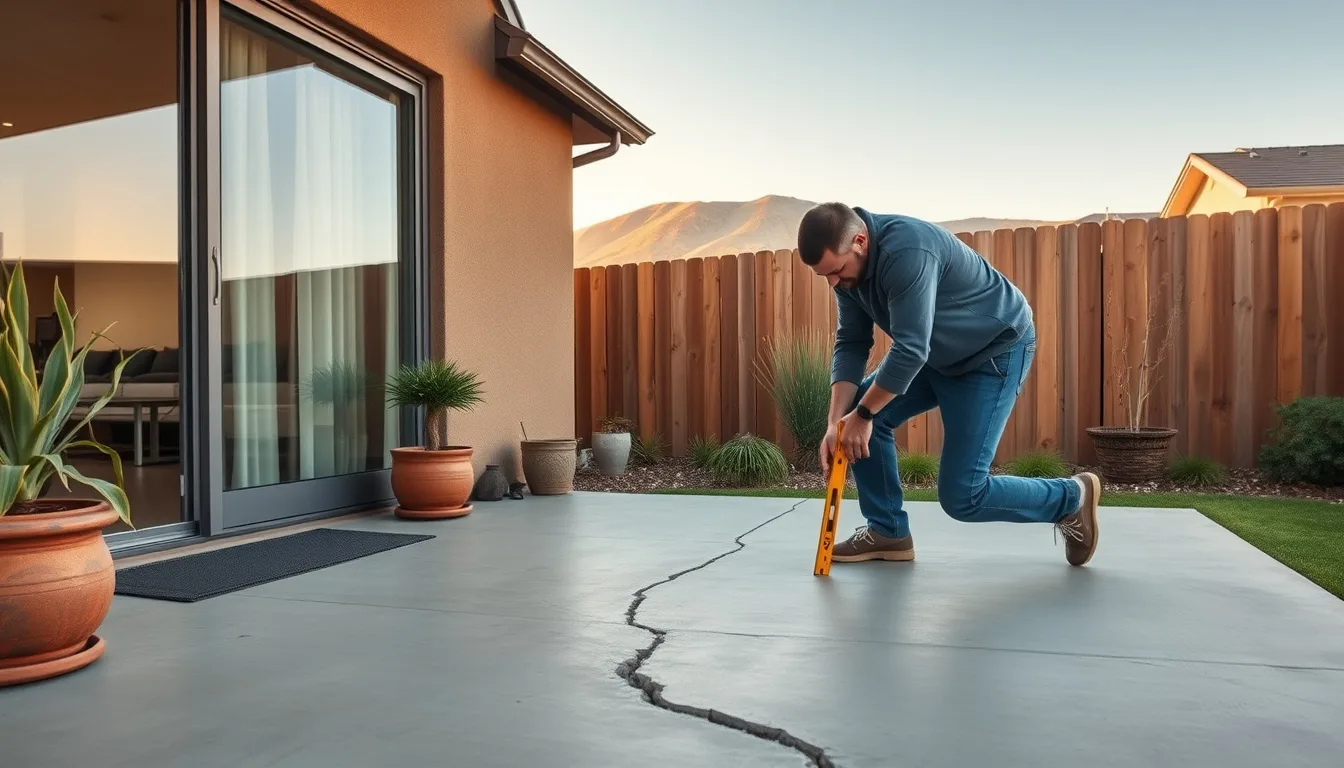
Patio damage typically shows up as one or a combination of three symptoms, and each points toward a slightly different repair. Cracking near the house wall, especially cracks that widen and narrow seasonally, usually signals active clay movement in the backfill zone rather than a one-time settlement event. A slab section that's visibly higher than its neighbor, or a gap opening up between the patio and a sliding door threshold, points to heave — clay swelling has pushed part of the slab upward.
A patio that pools water against the house after rain, even without visible cracking, is showing negative slope — the surface has tilted enough to reverse drainage even if the concrete itself still looks intact. We check the true grade with a level during every inspection, because a negative-slope patio without obvious cracks is still an active problem, just one you can't diagnose by eye alone.
Repair Options: Crack Injection, Lifting, or Resurfacing
Which repair fits a given patio depends on which symptom is dominant. Active or widening cracks over a still-structurally-sound slab typically get flexible polyurethane injection rather than rigid epoxy, since a rigid fill can crack again right next to itself if the clay underneath is still actively moving — epoxy is reserved for cracks that have stabilized and aren't tied to ongoing soil movement. Heaved or sunken sections get lifted and releveled with polyurethane foam, injected through small entry holes that don't disturb the surrounding finish.
When the surface itself has taken freeze-thaw or salt-adjacent scaling damage but the slab underneath is sound, a bonded resurfacing overlay restores a uniform, sealed surface without a full tear-out — a common next step after crack repair or lifting on an older patio that's taken years of winter exposure. We sequence these correctly: address any active movement and drainage first, then resurface, so the new surface isn't immediately undermined by the same problem that damaged the old one.
Preventing Recurrence: Drainage, Grading, and Irrigation Control
Because expansive clay only swells when it gets wet, the single most effective thing a homeowner can do between repairs is control how much water reaches the soil under and around the patio. That means directing downspouts well away from the foundation and patio edge, regrading any low spots that pool water against the slab, and adjusting sprinkler heads that spray directly onto the backfill zone near the house.
None of that replaces the concrete repair itself, but it does slow how fast the clay cycles between wet and dry — which is directly tied to how often a patio needs releveling. On the most active expansive-soil sites, some patios may still need a follow-up releveling after a particularly severe wet-to-dry swing even with good drainage control, and we'll tell you upfront if a property looks like one of those cases rather than promise a permanent fix that the soil itself won't allow. A five-minute walk around the property after a heavy rain — checking whether water is pooling near the patio edge or draining away cleanly — is the simplest ongoing check a homeowner can do between our visits, and it's the same check we run on every follow-up inspection.
Typical Patio Repair Cost
Crack repair on a patio follows standard per-linear-foot pricing: roughly $5 to $8 for hairline caulk work, $8 to $15 for chiseled structural filler, and $15 to $25-plus for reinforced epoxy or flexible polyurethane injection on wider or active cracks. Lifting and releveling a sunken or heaved patio section is priced by square footage and how much void needs filling underneath, and typically costs less than full replacement while preserving an existing stamped or decorative finish that a fresh pour can't match.
Resurfacing runs roughly $3 to $5 per square foot for a basic single-color overlay, up to about $9 per square foot where damage is more extensive, and $7 to $20 per square foot for decorative stamped or textured finishes. Every patio quote follows an on-site inspection, since the right combination of methods — and the true cost — depends on how much of the damage is soil-driven versus surface-level.
Get a Free Patio Inspection
If your patio is cracking near the house, pulling away from a door threshold, or draining the wrong direction after rain, those are all worth a look before the next wet-dry swing makes the movement worse. We inspect the slope, check for active versus stabilized cracking, and give you a fixed-price plan that addresses the concrete and the drainage together.
Get in touch through our contact form for a free patio inspection anywhere along the Front Range or statewide — inspections and quotes are always free, and we'll tell you plainly whether your patio needs a simple crack seal or a full lift-and-releveling job.
Patio Repair FAQs
Straight answers before we drill
Patios sit on backfill placed against the foundation during construction, which is exactly where Front Range expansive clay concentrates its seasonal swelling and shrinking. Documented seasonal ground movement of 2 to 6 inches in affected areas can crack a patio slab or open a gap between the patio and a door threshold as the clay beneath the backfill zone moves independently of the house's pier foundation.
This usually happens when expansive clay under the foundation-side edge of the patio swells more than the yard-side edge, tilting the slab back toward the house. It creates a feedback loop — water then pools against the foundation instead of draining away, feeding more clay swelling. Correcting the slope, usually through lifting and re-leveling, is necessary alongside any surface repair or the tilt will keep recurring.
Yes — re-establishing a positive slope away from the house is part of most patio repairs, not a separate add-on. Fixing the concrete without correcting the drainage direction just sets up the same clay-swelling cycle to recur, so we address both together whenever the slab has developed negative slope.
Patios rarely get cleared of snow and ice the way a driveway or sidewalk does, so they hold moisture and cycle through more freeze-thaw events in a wet state. With roughly 149 freeze-thaw cycles a year on the Front Range and water expanding about 9% each time it freezes, that extra dwell time on an uncleared patio can produce visibly worse scaling than the rest of the property.
In most cases, yes. Cracks are typically sealed or epoxy-injected, and a heaved or sunken section is usually lifted and releveled with polyurethane foam injection rather than replaced. Full replacement is reserved for patios broken into multiple large pieces or with widespread structural spalling — we'll tell you honestly which category yours falls into during the inspection.
Cracked, sinking, or salt-damaged concrete? Get a fixed price before we drill.
Free inspections statewide. We diagnose freeze-thaw, de-icing salt, and expansive-soil causes before recommending a repair.