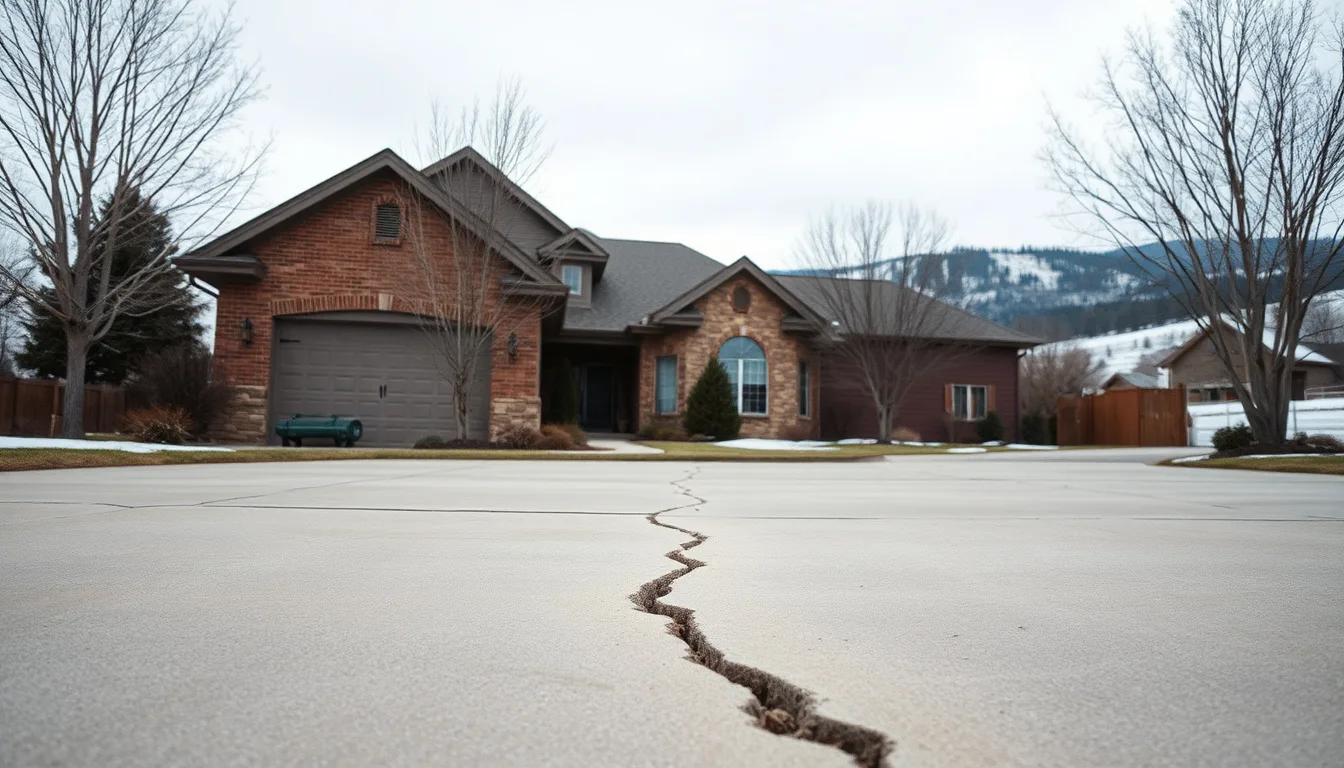
Driveway Repair — Statewide Colorado
Driveway Repair in Colorado — Crack, Scaling, Heave, and Leveling Fixes for Front Range Driveways
No surface on your property takes a harder beating than the driveway. We diagnose which of Colorado's three damage mechanisms is at work and fix the right one — not just the symptom.
Why Driveways Take the Worst of All Three Colorado Damage Mechanisms
Every other slab on your property deals with one or two of Colorado's damage mechanisms. Your driveway deals with all three at once. It gets the heaviest de-icing salt exposure of any surface — the magnesium chloride and calcium chloride you apply directly, plus the salt-laden slush and runoff that snowplows and passing traffic track and splash onto it all winter. It absorbs the heaviest freeze-thaw joint stress, because vehicle weight flexes panels at the control joints exactly where water collects and refreezes. And it sits directly over the same expansive Pierre Shale and bentonite clay driving seasonal heave everywhere else on the Front Range, with the added complication of the approach slab and garage apron transition.
That combination is why driveways are usually the first concrete on a Colorado property to show visible damage, and why a driveway repair often needs more than one type of fix in the same visit — a crack from soil movement, scaling from salt exposure, and a dropped panel at the garage apron can all show up on the same 20-year-old slab.
The Front Range averages roughly 149 freeze-thaw cycles a year, and every one of those cycles works against a driveway that's already carrying vehicle load and direct de-icer contact — which is a meaningfully harder combination than a patio or walkway sees. On mountain-corridor driveways above 5,000 feet, intense high-altitude sun can thaw ice even in sub-freezing air, adding still more melt-refreeze cycles on top of the Front Range baseline.
Reading the Symptoms: Which Cause Is Doing What
Cracks that run diagonally from a corner, change width along their length, or track with wet-dry seasons point to expansive clay movement underneath. Surface pitting, flaking, and a rough, exposed-aggregate texture — especially concentrated near where you apply de-icer or where plow slush collects — point to freeze-thaw and chloride scaling. Chunks breaking off at joints or edges, sometimes with rust staining visible in the break, mean scaling has progressed into spalling and reached the rebar. A hollow, drumming sound when you tap a section with a hammer handle is a reliable sign of a void underneath, even before any visible cracking shows up on the surface.
A panel sitting noticeably lower than its neighbor, or a gap opening at the garage apron, points to settlement or clay shrinkage rather than surface damage — that's a lifting and leveling problem, not a crack or resurfacing one. Most driveways showing real age have at least two of these symptoms present at the same time.
Where the damage shows up on the slab is also a clue. Damage concentrated near the street or curb, where snowplow slush pools, usually points to salt-driven scaling. Damage concentrated at the garage apron or along a single control joint that runs perpendicular to the house often points to soil movement directly under that joint rather than damage spread evenly across the whole driveway.
The Decision Tree: Crack Injection, Scaling Repair, Resurfacing, or Lifting
We start every driveway job by mapping which symptoms are present, then matching each one to the right method rather than defaulting to a single fix for the whole slab. Isolated structural or hairline cracks get epoxy injection or flexible polyurethane injection, depending on whether the crack is still actively moving with the soil underneath. Surface scaling and isolated spalling get chip-out patching or spot repair.
Where scaling and pitting are spread across most of the surface but the base is still sound, a bonded resurfacing overlay restores a uniform, sealed driveway surface in one pass rather than patching dozens of small spots. Where the real problem is elevation — a dropped panel, a heaved apron, a gap at the garage — mudjacking or polyurethane foam lifting brings the slab back to grade. Many driveways need two of these in the same visit: lift a settled panel, then reseal and patch the scaling that's been building on the surface for years.
Cost Bands by Repair Method
Crack repair on a driveway typically runs $5 to $8 per linear foot for hairline caulking, $8 to $15 per linear foot for chiseled structural filler, and $15 to $25-plus per linear foot for epoxy or flexible injection on wider cracks. Scaling and spalling repair runs roughly $20 to $50 per square foot for a minor surface patch and $50 to $150 per square foot where rebar cleaning and treatment is involved.
A full resurfacing overlay typically runs $3 to $9 per square foot depending on how much prep the existing surface needs, or $7 to $20 per square foot for a decorative or stamped finish. Lifting and leveling costs vary by method and volume of void fill — mudjacking is the lower up-front cost per square foot, polyurethane foam costs more per square foot but lasts longer. We give one fixed price covering everything your driveway actually needs after an on-site inspection, not separate guesses per problem.
In almost every case, combining repairs into a single driveway visit costs less than treating each symptom as a separate job over several seasons — and it's still a fraction of the cost of tearing out and replacing the slab, which is why full replacement is usually our last recommendation rather than our first.
Sealing Your Driveway for Next Winter
Whatever repair a driveway needs today, sealing it afterward is what keeps the same damage from reappearing next winter. A penetrating sealer reduces how much salt-laden meltwater gets into the concrete's pore structure, which is the shared mechanism behind both freeze-thaw scaling and rebar corrosion — the two damage paths a driveway is most exposed to of any surface on the property. Skipping the sealing step after a repair is the single most common reason a fixed driveway shows the same damage again within a few winters.
We build a sealing step into most driveway repairs, and recommend resealing on a multi-year schedule rather than treating it as a one-time step, since sealer wears down faster on a driveway than on lower-traffic surfaces given the combination of vehicle traffic, UV exposure, and direct de-icer application.
The Garage Apron and Approach Slab: A Recurring Trouble Spot
The transition where your driveway meets the garage floor and the street approach is one of the most common failure points we see, because it sits at the seam between different pours, different soil conditions, and often different drainage — exactly where expansive clay movement and freeze-thaw stress concentrate. A dropped or heaved apron creates a trip and vehicle-clearance problem even when the rest of the driveway looks fine.
We inspect this transition specifically on every driveway visit, since a small lift or crack repair at the apron now is meaningfully cheaper than letting the gap widen into a full panel replacement later. It's also one of the first spots we check when a homeowner reports a new rattle, drop, or scrape as they pull in or out of the garage.
Get Your Driveway Estimate
Send us a couple of photos of your driveway and your city, or book a free on-site inspection anywhere in Colorado. We assess which of the three causes is actually driving the damage — soil movement, freeze-thaw, salt exposure, or a combination — before recommending a fixed-price repair, rather than quoting blind over the phone.
Get in touch through our contact form. Please clear vehicles from the driveway before your scheduled visit so we can inspect and work the full surface.
We repair driveways statewide, with regular jobs across Denver, Aurora, Lakewood, Arvada, Westminster, Thornton, Centennial, Colorado Springs, Fort Collins, Boulder, and Pueblo.
Driveway Repair FAQs
Straight answers before we drill
If the slab is a single piece with surface damage — cracks, scaling, unevenness — and sounds solid when tapped, repair almost always makes sense. If it's broken into multiple large pieces, has severe structural spalling exposing corroded rebar throughout, or has settled or heaved so badly that leveling can't restore a usable surface, replacement is usually the honest answer.
Crack injection and spot repairs are usually done in a single visit of a few hours. Resurfacing and lifting or leveling jobs typically take one day for a residential driveway. If your driveway needs more than one type of repair, we scope and complete it in the same visit whenever possible.
Yes — please clear vehicles and any items from the driveway before your scheduled repair so we can inspect and work the full surface. We'll tell you the expected cure or wait time before you can park or drive on the repaired area again.
Yes — inspections and quotes are free across our Colorado service area. We assess the actual cause of the damage before recommending a fixed-price repair, rather than quoting blind over the phone.
Crack injection can be done in cold weather with the right materials, but most exterior resurfacing, overlay, and new-material curing work needs temperatures reliably above freezing — which is also exactly why spring is the highest-demand season for repairing the winter's freeze-thaw and de-icing-salt damage. We recommend booking a spring inspection as soon as the snow clears.
Cracked, sinking, or salt-damaged concrete? Get a fixed price before we drill.
Free inspections statewide. We diagnose freeze-thaw, de-icing salt, and expansive-soil causes before recommending a repair.